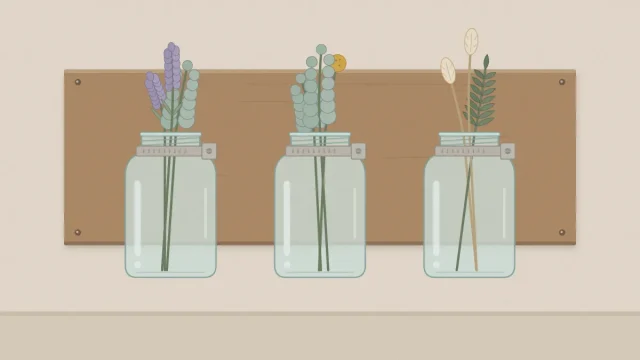
Mason Jar Shelf Decor: How to Style Jars in Groups
How to arrange mason jars on open shelves and mantels: group in threes, mix clear, painted and filled jars, hold the palette to a few colors and leave space so the shelf never looks crowded.
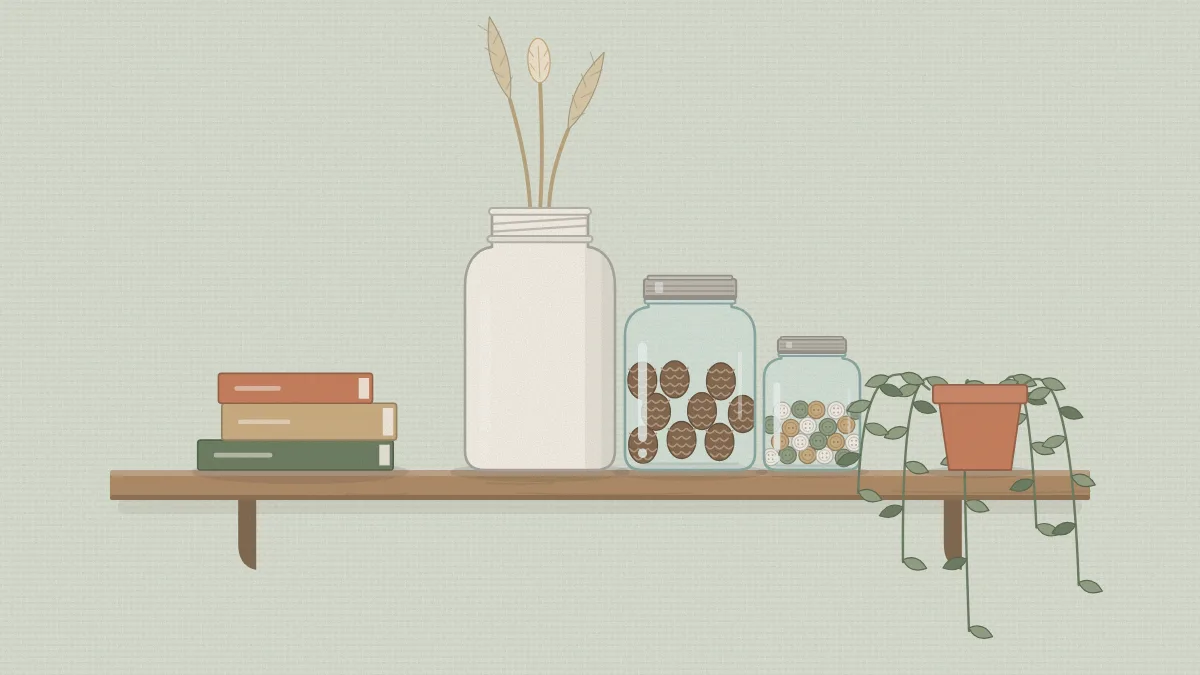
Good mason jar shelf decor is mostly a matter of editing. A single jar looks lost on a long shelf, and ten jars in a row look like storage, so the work is in choosing a few, grouping them well and leaving the rest of the shelf alone.
The ideas below apply to open wall shelves, bookcases and mantels. None of them needs new supplies: you can rearrange jars you already have, then decide whether one of them should be painted or filled to finish the group.
Start by clearing the shelf
Take everything off the shelf before you style it. It is far easier to build an arrangement on an empty surface than to squeeze jars into the gaps between things that are already there.
Wipe the shelf, then check each jar for chips and cracks as you handle it. Recycle damaged jars rather than displaying them, because a cracked jar can fail when it is moved. Wash dusty jars in warm soapy water, avoid sudden temperature changes, and let them dry completely.
Group jars in threes
Odd numbers read as a group, while even numbers tend to read as pairs or rows. Three is the easiest number to work with: it is enough to look deliberate and small enough to leave space around it.
Set the three jars in a loose triangle instead of a straight line. Put the tallest jar at the back, slightly off center, and bring the two shorter jars forward on either side so each one overlaps the next a little when you look from the front. On a shelf about 8 in (20 cm) deep, that usually means one jar near the back edge and two near the front.
Vary the heights. A quart with a pint and a half-pint works well, and so does a pint raised on two books beside a pint standing on the shelf. Three jars of identical size and height look flat, however nicely they are finished.

Mix clear, painted and filled jars
A group is more interesting when each jar does a different job. A reliable mix is one painted jar, one clear jar with something inside it and one jar holding stems.
- Painted: a solid, matte jar gives the eye a place to rest. A soft, worn finish suits a rustic shelf, and the method for distressed painted mason jars covers it step by step.
- Filled: a clear jar with a dry filler adds texture without adding color. Pinecones, smooth stones and wooden beads all work, and the guide to mason jar fillers lists more options by look.
- Stems: height comes from dried grasses or artificial flowers. If you want the look of a bouquet with no water on the shelf, see the notes on faux flower mason jars.
Limit the palette to two or three colors
Choose two or three colors for the whole shelf and repeat them. Cream, a muted green and the brown of jute twine is one calm combination. White, soft blue and natural wood is another.
Count everything on the shelf as part of the palette, including book spines, plant pots and the fillers inside clear jars. If the books are bright, turn a few spines to the back or stack them flat so the page edges show.
Tip
If a shelf feels busy and you cannot tell why, take away the one item whose color appears nowhere else. That single change often settles the whole arrangement.
Leave empty space on purpose
Empty shelf is part of the arrangement. A useful starting point is to leave roughly a third of each shelf bare, in one continuous stretch instead of small gaps between every object.
On a single shelf, push the jar group toward one end and let the other end hold a low object or nothing at all. On a bookcase with several shelves, alternate sides: a group on the left of one shelf, then on the right of the next. The eye moves in a gentle zigzag instead of running down one heavy column.

Pair jars with books and plants
Jars look best next to things that are not jars. Books and plants are the two easiest partners, because one is flat and solid and the other is soft and irregular.
- Stack two or three books flat and stand a small jar on top. The stack acts as a platform and solves the height problem at once.
- Stand a few books upright and use a heavy filled jar as a bookend.
- Place a trailing plant at one end of the shelf so its stems fall past the edge, with the jar group at the other end to balance it.
Keep live plants in their own pots with saucers. Water spilled on a shelf can mark the wood and lift the finish at the base of a painted jar.
Styling a mantel
A mantel is a long, narrow shelf seen from across the room, so everything needs to be slightly bigger and simpler. Use quart jars as the main pieces and keep small jars for close-up shelves.
Two arrangements work on most mantels. The first is asymmetrical: a tall group of three at one end and a single low object at the other. The second is symmetrical: a matching jar of stems at each end and one lower piece in the middle.
Watch out
Keep jars and dried or artificial stems off a mantel above a working fireplace, and never light anything inside a jar. If you want a glow on the shelf, use battery-operated LED string lights and follow the maker’s instructions.
How to tell when it is cluttered
Step back to the far side of the room and look at the shelf for a few seconds. A cluttered shelf has no obvious place to look first. A styled one has a clear main group and quieter areas around it.
If it still feels crowded, work through these fixes in order:
- Remove one jar from every group of more than three.
- Take out anything smaller than your fist, since tiny objects look like leftovers from a distance.
- Check that no two neighboring items are the same height.
- Move the remaining pieces closer together within each group, and wider apart between groups.
Frequently asked questions
How many mason jars should go on one shelf?
Three is a good limit for a shelf up to about three feet wide. A longer shelf can take two groups if there is a clear stretch of empty surface between them. When every jar you own is on display at once, the shelf starts to look like storage, so keep the extras in a cupboard and rotate them.
Should the jars on a shelf all match?
They should relate without being identical. Keep one thing consistent, such as the color family or the finish of the screw bands, and vary the rest: size, height and what each jar holds. A painted jar, a clear filled jar and a jar of stems look like a set because the colors repeat, even though no two are alike.
How do I stop jars from sliding or tipping on a narrow shelf?
Choose jars that sit fully on the shelf with a little room to spare, and place the heaviest ones at the back. A thin non-slip pad or a few clear furniture bumpers under each base adds grip. Keep tall stems short enough that the jar stays stable, and keep glass off shelves that children or pets can reach.