Mason Jar Labels: Tags, Chalkboard Panels and Clear Stickers
Five ways to label a mason jar compared: hang tags, kraft and clear stickers, a painted chalkboard panel and lid-top labels, with placement and writing tips.
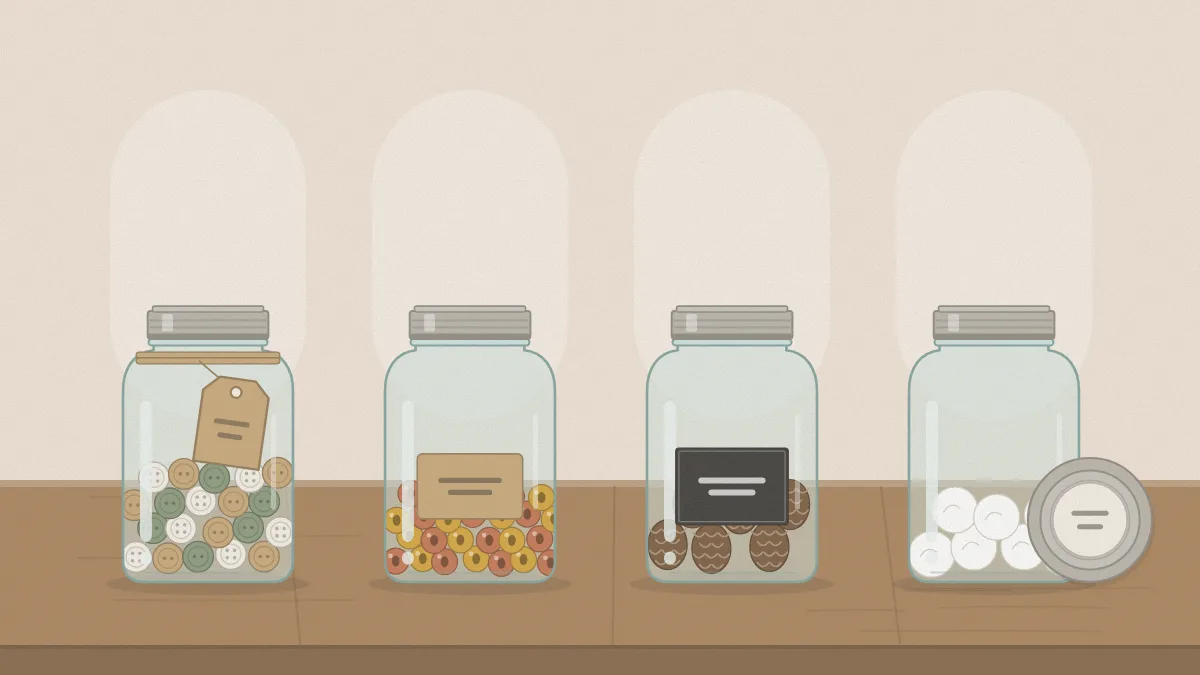
A row of matching jars looks tidy until you need the one holding the small buttons and have to lift three lids to find it. Mason jar labels solve that, and they also finish the look of a shelf: a plain tag or a neat dark panel can be the only decoration a jar needs.
There are five common ways to label a jar, and each suits a different job. The sections below compare them so you can pick one style and repeat it across a whole set.
Five label styles at a glance
The main question is how often the contents change. A jar that always holds the same thing can take a permanent label. A jar that rotates between projects needs a label you can wipe, swap or untie.
| Label style | Best for | How easy to change | Where it sits |
|---|---|---|---|
| Hang tag on twine | Jars whose contents change often, embossed jars | Very easy: untie or rewrite the tag | Around the neck, below the threads |
| Kraft paper sticker | A warm, rustic matching set | Moderate: peel and replace | Smooth side panel |
| Clear sticker | A clean look where the contents stay visible | Moderate: peel and replace | Smooth side panel |
| Chalkboard-finish panel | Jars that are relabeled again and again | Easy: wipe and rewrite | Painted on the smooth side |
| Lid-top label | Jars stored in a drawer or low crate | Easy: swap the round label | On the flat lid insert |
Hang tags on twine
A hang tag is the most forgiving label because it never touches the glass. Punch a hole in a small card tag, thread it onto jute twine, and tie the twine around the neck of the jar just below the screw threads, where the shoulder stops it from sliding down.
Tags are also the easy answer for heavily embossed jars, where there is no flat area for a sticker. If you enjoy making your own, the shapes and tying methods in the guide to mason jar gift tags work just as well for everyday storage jars.
Kraft and clear stickers
Stickers give the neatest result on smooth glass. Kraft paper labels have a matte brown surface that takes ink well and suits a rustic shelf. Clear stickers almost disappear, so the writing seems to float on the jar and you can still see what is inside.
Both types need clean, dry glass. Wipe the area with a little rubbing alcohol on a cloth, let it dry, then press the label down from the center outward so no air is trapped under it. On a curved jar, a small or narrow label lies flatter than a large one, which tends to lift at the corners.

A painted chalkboard panel
A chalkboard-finish panel is a small rectangle or oval of dark paint on the outside of the jar that you write on with chalk.
- Clean the smooth side of the jar and let it dry completely.
- Mask a rectangle with painter’s tape, pressing the inner edges down firmly.
- Brush on a thin coat of chalkboard-finish paint, working from the tape toward the middle.
- Let it air dry as the label directs, then add a second thin coat.
- Peel the tape slowly and leave the panel to dry for as long as the paint label says before writing on it.
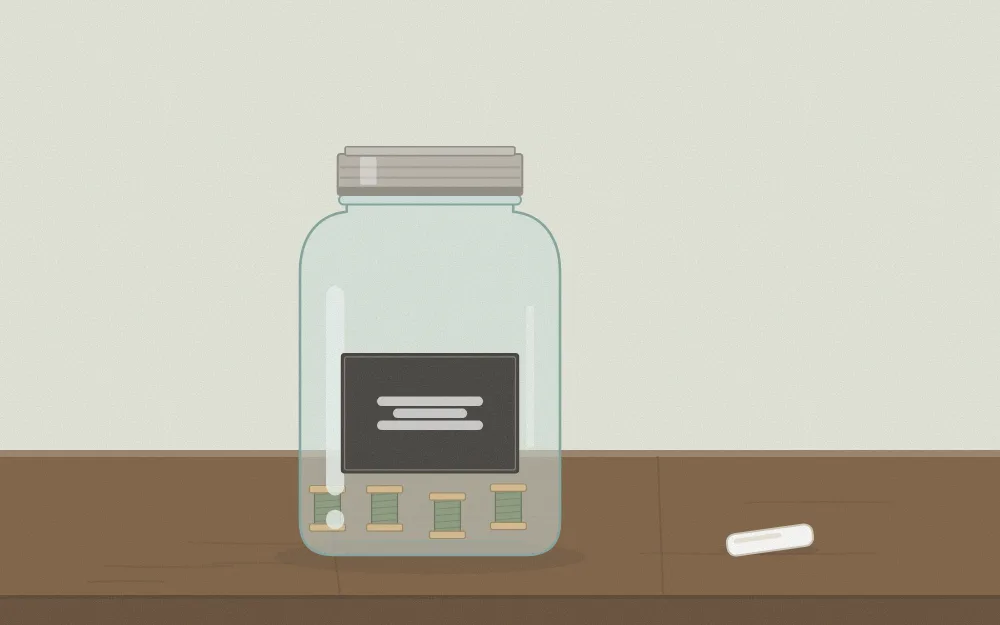
Not every chalkboard-finish paint is made for glass, so read the label for surface suitability and follow any preparation it asks for. The comparison of the best paint for mason jars explains how this paint type behaves next to chalk-style and acrylic paints.
Watch out
Keep the panel on the outside of the jar and clear of the rim. A painted jar is for decorative storage only, and the paint should be wiped with a barely damp cloth, never soaked.
Lid-top labels
When jars live in a drawer, a deep crate or a low shelf, you look down on them, and a side label is useless. A round label on the flat lid insert fixes that.
A regular-mouth lid is about 2 3/4 in (70 mm) across and a wide-mouth lid about 3 3/8 in (86 mm), so round labels of about 2 in (5 cm) and 2 1/2 in (6.5 cm) fit inside the screw band with a visible margin. Lids vary by maker, so measure yours before buying a full sheet.
Where to place a label on embossed glass
Most mason jars have raised lettering or a logo on one side and a smooth panel on the opposite side. Stickers and painted panels belong on the smooth side. A sticker laid over raised lettering bridges the gaps, traps air and peels within days.
Some jars are embossed all the way around, or have raised measurement marks on the back. For those, use a hang tag or a lid label. Whatever you choose, place every label at the same height across the set.
Writing tools by type
- Stick chalk: soft and dusty, with a casual look. It wipes off a chalkboard panel with a dry cloth and suits labels that change weekly.
- Liquid chalk marker: gives sharp, opaque lines on a chalkboard panel. Test it in a corner first, because on some painted surfaces it leaves a faint shadow when wiped.
- Oil-based paint pen: a lasting choice for kraft tags, clear stickers and writing directly on glass. Use it in a ventilated room and let it dry as the pen directs.
- Fine permanent marker: good on paper tags and kraft stickers. On clear stickers and bare glass it can smear until fully dry.
Removing and replacing labels
Paper stickers usually lift if you peel slowly from one corner. If paper or adhesive stays behind, soak a cloth in warm soapy water, lay it over the patch for a few minutes, and rub the residue away. A drop of cooking oil or rubbing alcohol on a cloth loosens stubborn adhesive. Wash the spot afterward so the next label grips, and avoid sudden temperature changes when rinsing glass.
Keep soaking and solvents to unpainted jars: on a painted jar they can lift the finish along with the label.
Once the labels are sorted, the next step is deciding what goes where. The guide to mason jar craft storage covers which jar sizes suit beads, ribbon, brushes and other supplies, so every label has a sensible home.
Frequently asked questions
What size label fits a mason jar lid?
A round label of about 2 inches suits a regular-mouth lid, and about 2 1/2 inches suits a wide-mouth lid. Both leave a small margin inside the screw band. Lid sizes vary a little between makers, so measure the flat insert of your own jar before you order or cut a full set.
Why do stickers keep peeling off glass jars?
The usual causes are a greasy or damp surface, a label placed over raised lettering, or a label too large for the curve of the jar. Clean the smooth side with rubbing alcohol, let it dry, and use a smaller label pressed down from the center outward.
Can you write directly on a glass jar?
Yes. An oil-based paint pen writes cleanly on bare glass and stays put once dry, and it can usually be removed later with rubbing alcohol. Liquid chalk markers also write on glass but rub off easily, which suits jars whose contents change often.