Mason Jar Flower Arrangements: A Beginner Guide
Arrange fresh flowers in a clear jar in three layers: greenery, focal blooms, then filler. Covers stem length, jar size for the bunch and quick fixes.
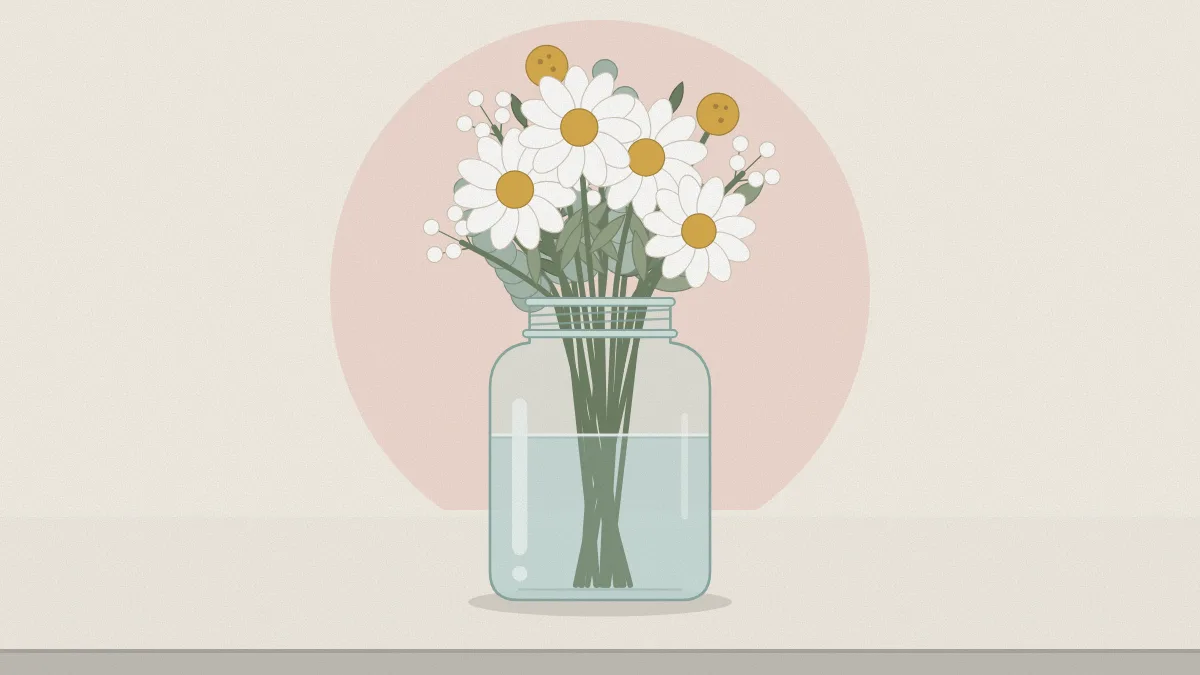
Tutorial at a glance
Materials
- Clean, clear unpainted jar
- Greenery stems
- Focal flowers
- Filler flowers
- Sharp scissors or pruners
- Fresh cool water
Mason jar flower arrangements are forgiving, which makes them a good place to learn. The straight sides and narrow neck hold stems more upright than an open vase does, and a clear jar suits anything from garden daisies to a mixed bunch from the market.
What separates a tidy arrangement from a bundle dropped in water is mostly order: cut to the right length, strip the lower leaves, then build in three layers. The steps below use fresh flowers and one clear jar.
Use a Clear, Unpainted Jar for Water
Fresh stems and water belong in plain, clear glass. Standing water can lift an exterior paint finish at the rim and base, so a painted or decorated jar is not the right container on its own.
If you want the look of a painted jar, stand a plain inner container inside it, such as a narrow glass or a plastic cup that fits through the mouth, and put the water and stems in that. Keep the painted surface dry when you top up.
Wash the jar in warm soapy water and rinse it well; avoid sudden temperature changes, which can crack glass. Check for chips and cracks at the rim, and recycle a damaged jar instead of using it.
Match the Jar to the Bunch
A jar that is too large lets stems fall outward and leaves a hole in the middle. One that is too small crushes them. Stem thickness varies, so treat these numbers as a starting point.
| Jar size | Stems, roughly | Good for |
|---|---|---|
| Half-pint (8 oz) | 5 to 7 short stems | Bedside table, place settings |
| Pint (16 oz) | 8 to 12 stems | Desk, windowsill, small table |
| Quart (32 oz) | 15 to 20 stems | One full market bunch, table center |
| Half-gallon (64 oz) | 25 or more | Tall branches and large blooms |
A regular-mouth jar grips a small bunch better than a wide-mouth jar. For a wide opening, or for a loose arrangement with few stems, a tape grid across the mouth keeps each stem where you place it.
Get the Stem Length Right
The most useful rule is proportion: the tallest stems should measure about one and a half to two times the height of the jar. A pint is roughly 5 in (13 cm) tall, so its tallest stems run about 8 to 10 in (20 to 25 cm). A quart, at roughly 7 in (18 cm), takes stems of about 11 to 14 in (28 to 36 cm).

Hold each stem against the outside of the jar and cut a little long. You can always trim more, and stems on the outer edge will be cut shorter than those in the center anyway.
Prepare the Stems
- Sort. Separate the bunch into three piles: greenery, focal flowers (the largest blooms) and filler (small, airy flowers).
- Strip. Remove every leaf that would sit below the water line. Leaves left under water break down quickly and cloud it.
- Cut. Trim each stem at a slant with clean, sharp scissors or pruners. Keep sharp tools away from young children.
- Fill. Fill the jar about two-thirds full with fresh, cool water.
Arrange in Three Layers
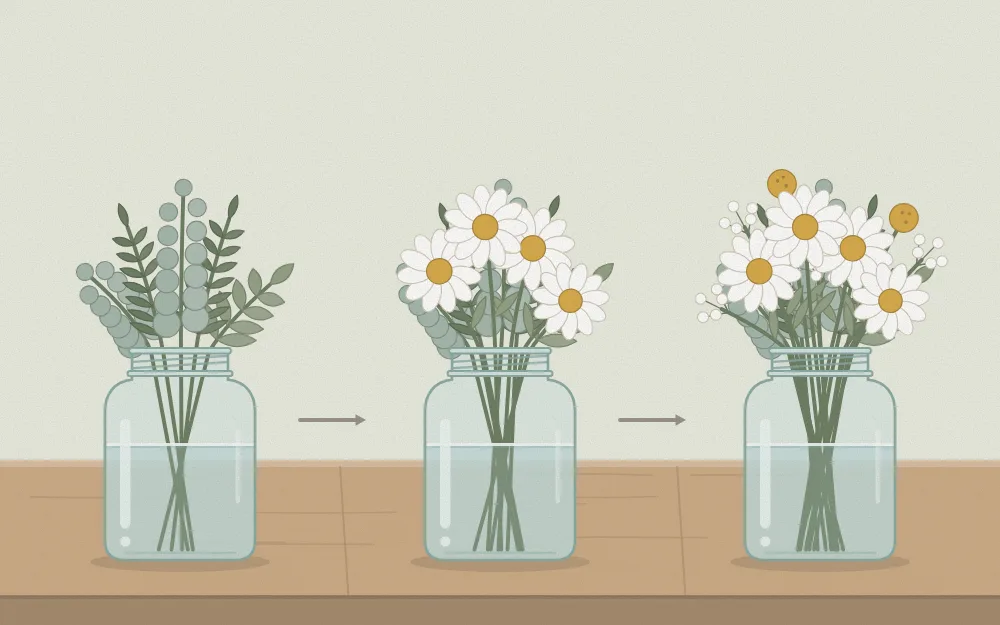
Work with the jar on the table in front of you and give it a quarter turn after every few stems. Turning is what keeps the arrangement even from all sides.
1. Greenery first
Place four to six stems of foliage around the rim, angled outward so they cross each other inside the jar. The crossed stems form a loose lattice that supports everything added after. Let a few leaves drape over the edge to soften the line of the glass.
2. Focal flowers
Add the largest blooms next, in odd numbers: three for a pint, five for a quart. Set one slightly taller near the center and the others lower and off to the sides, each at a different height. Push each stem through the greenery until it reaches the bottom.
3. Filler last
Tuck small flowers into the gaps, spacing them around the jar instead of clustering them on one side. Stop while there is still a little air between blooms; a jar arrangement looks best slightly loose.
Tip
Step back about 3 ft (1 m) and look at the outline before adding the last stems. A soft dome or a gentle lean to one side both work; a flat top usually means the center stems need to be a little taller.
Fix Common Problems
- Stems fall to the sides. Add more greenery to tighten the lattice, move to a smaller jar or use a tape grid.
- Everything is the same height. Lift the center focal flower and trim the outer stems by about 1 in (2.5 cm).
- The arrangement looks sparse. Cut all stems shorter. Shorter stems spread less and fill the opening.
- Heavy blooms tip the jar. Use a quart or larger and keep the tallest stems within twice the jar height.
Keep It Looking Fresh
Change the water every day or two, and trim a small amount from each stem when you do. Pull out any flower that has faded so the rest keep the display going. Set the jar out of direct sun and off surfaces that water rings could mark; a small saucer or coaster underneath helps.
Watch out
Some common cut flowers and foliage are harmful to pets if chewed. Check the plants in your bunch and keep the jar away from cats, dogs and young children if you are unsure.
Where to Go Next
For a display that needs no water and can sit in a painted jar, faux flower mason jars use the same three-layer order with artificial stems. To use several jars along a table, the guide to mason jar centerpiece ideas covers grouping, heights and spacing.
Frequently asked questions
How long should flower stems be for a mason jar?
Aim for the tallest stems to be about one and a half to two times the height of the jar. For a pint that is roughly 8 to 10 inches, and for a quart about 11 to 14 inches. Cut the outer stems a little shorter so the arrangement forms a soft dome.
How many flowers fit in a quart mason jar?
Roughly 15 to 20 stems, which is about one full market bunch including greenery. The exact number depends on how thick the stems are. If the stems still lean outward, add a few more pieces of foliage or switch to a pint for a smaller bunch.
Can fresh flowers go in a painted mason jar?
Not directly. Water standing against the rim and base can lift an exterior finish. Place a plain inner container, such as a narrow glass or plastic cup, inside the painted jar and put the water and stems in that, keeping the painted surface dry.

